By Go Suan Pau
When Zomi people speak of dangka, they are not simply naming money. The word carries a history of trade, political change, regional interaction and cultural memory. In Zomi language, dangka is commonly used in reference to money or monetary value. Historical Zomi material even uses the term for currencies such as the Burmese kyat, Indian rupee and dollar. In other words, dangka has survived not because Zomi communities have maintained a sovereign currency, but because the word has remained embedded in the language.
That distinction matters.
There is a temptation to describe dangka as an ancient Zomi currency and, in doing so, to turn a fascinating linguistic tradition into an unsupported historical certainty. The evidence available today tells a more complicated, and arguably more interesting, story. Dangka appears to belong to a much wider Asian family of monetary words, while its use among Zomi communities reflects centuries of interaction with neighbouring peoples and economic systems.
The history of dangka cannot be separated from the history of tanka, tangka, taka and tanga. These related forms have appeared across South and Central Asia and have been used for coins and, more broadly, money.
Yule and Burnell's Hobson-Jobson traces tanga and tanka to the Sanskrit ṭaṅka, associated with a weight of silver and a stamped coin. The authors also note that the forms ṭakā and ṭanga came to be used broadly for money. Their historical examples demonstrate that tanka was not the property of one nation or community: it appeared in the monetary vocabulary of different societies over a vast geographical area (Yule and Burnell, 1903).
This history provides an important context for understanding dangka. It does not, however, prove that the Zomi word was directly borrowed from one particular language. Linguistic resemblance is not sufficient evidence of a direct borrowing. The precise pathway by which dangka entered and developed in Zomi language remains a subject deserving systematic comparative research.
But the broader connection is compelling. Across Asia, words related to tanka repeatedly became associated with silver, coins and money. The monetary vocabulary travelled with people, commerce and political influence.
The history of the Tibetan tangka provides an especially useful comparison.
Tibetan tangkas were part of a complex monetary system connecting Tibet with Nepal and other Himalayan trading centres. Coins associated with the tangka denomination were produced in Nepal and circulated in Tibet, while Tibetan authorities later produced their own tangkas. The history of these coins illustrates a fundamental feature of pre-modern money: currency did not necessarily respect political borders.
Coins could be produced in one country, carried by merchants into another and adopted within a different political and linguistic environment. Monetary terminology could travel in the same way.
This is precisely why the history of dangka should be examined through the lens of regional exchange rather than through the assumption of an isolated Zomi monetary system.
Indeed, recent numismatic research has identified tanka terminology in monetary contexts extending into the eastern regions of the Indian subcontinent and Arakan, while historical evidence also associates the denomination with the Pyu world. This opens an important avenue for investigating the historical circulation of monetary concepts across the regions surrounding the Zomi homeland.
Perhaps the strongest evidence for the historical importance of dangka comes not from a surviving Zomi coin but from the way the word appears in historical descriptions of Zomi economic life.
David Vumlallian's study of the Kam Hau polity provides a particularly valuable example. In describing the taxation system established by Kam Hau in the Tedim area, Vumlallian records a sales tax of one rupee, described as dangka, for every animal sold in the open market (Vumlallian, 2009, p. 213).
This is an important piece of evidence.
It shows dangka functioning as a monetary term within the political economy of the Tedim area. The evidence does not suggest that Kam Hau necessarily minted a coin called dangka. Rather, it shows that the word could be used to identify a monetary payment, in this case, a rupee.
That distinction allows us to understand Zomi monetary history without diminishing it. A society does not need to operate its own mint or issue a sovereign currency for money to have a meaningful place in its history.
The Kam Hau example shows money operating within taxation, markets and political authority. Dangka, therefore, was not merely an abstract word. It was connected to the practical economic life of Zomi communities.
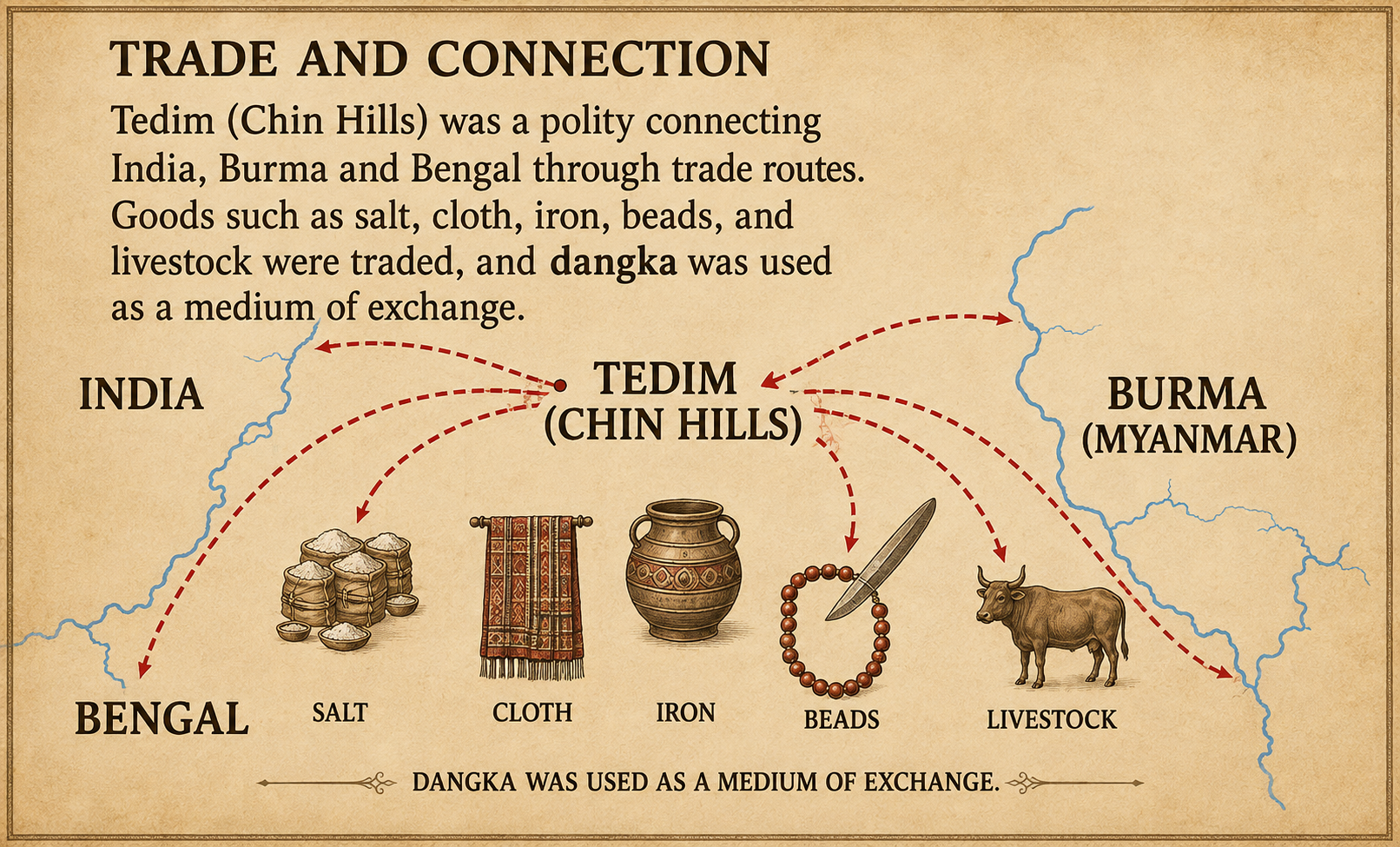
Zomi communities historically lived at the intersection of several political and economic worlds. Their territory and trading relationships connected present-day Myanmar, India and Bangladesh. As political boundaries changed, the currencies circulating through these communities changed as well.
Zomi cultural-historical material records dangka as a general term encompassing currencies including the Burmese kyat, Indian rupee and dollar. It also proposes a connection between the Zomi term and monetary terminology such as the tangka of East Pakistan/Bangladesh and the Burmese derga (Zomi Cultural Heritage and History, n.d.).
This adaptability is perhaps the most important characteristic of dangka.
The currency could change, but the word remained.
A rupee could be dangka. A kyat could be dangka. A dollar could be dangka. The political authority printed on the note was less important than the economic function of the object itself.
This is what makes dangka a form of linguistic economic memory.
Here the historical discussion becomes more controversial.
J. Thang Lian Pau's Zomi Khangthu places the use of Dangka (Taka) remarkably early, recording under AD 4 that the Zomi were believed to have possessed Dangka (Taka) (Thang Lian Pau, 2002).
For many Zomi readers, such a reference is significant because it places money within a broader narrative of ancient Zomi history.
But historians must distinguish between historical tradition and independently verified evidence.
At present, the statement does not appear to be supported by a securely identified Zomi coin, archaeological excavation, contemporary inscription, mint record or independent numismatic corpus demonstrating that a specifically Zomi dangka was minted in AD 4 (Thang Lian Pau, 2002).
That does not make the tradition worthless. Quite the opposite: it makes it a research question.
The responsible position is neither to dismiss the tradition nor to present it as proven fact. Instead, it should be recorded as a Zomi historiographical tradition that requires further archaeological, linguistic and numismatic investigation.
Perhaps somewhere in a museum collection, private collection, archaeological site or forgotten manuscript lies evidence capable of answering the question.
Perhaps the most important legacy of dangka is not a coin at all.
It is the word.
Currencies disappear. Governments change. Borders move. Coins are melted down, banknotes become obsolete and monetary systems are replaced. Yet words can survive.
The continued use of dangka demonstrates how economic history can become embedded in language. It preserves a memory of a world in which Zomi communities participated in markets and interacted with monetary systems extending far beyond their immediate villages.
Seen this way, dangka is a linguistic artefact.
It tells us that Zomi history should not be written solely through the records of colonial governments or neighbouring states. The vocabulary of the Zomi people itself can provide evidence about their historical engagement with trade, taxation and regional commerce.
This is particularly important for communities whose history has often been documented through external administrative categories. Indigenous vocabulary can preserve historical information that formal archives overlook.
The search for an ancient Zomi coin called dangka is understandable. A physical coin would provide powerful and tangible evidence of Zomi economic history.
But the absence of such a coin should not lead us to conclude that dangka has no historical significance.
The more productive question may be:
How did the concept and vocabulary of money travel into Zomi society, and how did Zomi communities adapt it to their own economic and linguistic world?
That question opens a much wider field of research.
It invites historians and linguists to examine trade routes between the Chin Hills, Manipur, Assam, Bengal and Burma; comparative vocabulary across Zomi and neighbouring languages; old missionary dictionaries; colonial administrative records; oral traditions; tax systems; market practices; archaeological evidence; and surviving coins and banknotes.
It also invites collaboration between Zomi scholars and specialists in numismatics, historical linguistics, archaeology and South and Southeast Asian history.
The story of dangka ultimately reminds us that heritage is not always preserved in monuments.
Sometimes it is preserved in a single word.
Dangka connects contemporary Zomi speakers with a much longer history of monetary exchange across South and Southeast Asia. Its relationship with the wider tanka/tangka/taka family of monetary terms provides a plausible regional context, while historical evidence from the Kam Hau polity demonstrates its practical use in monetary transactions.
What we cannot yet establish is equally important: there is insufficient evidence to confidently claim that an independently minted sovereign Zomi currency called dangka existed in antiquity.
But that uncertainty should not close the historical investigation. It should begin it.
The history of dangka deserves to move beyond folklore and into systematic scholarship. Zomi researchers could establish a dedicated Zomi Numismatic and Economic History Project, documenting oral traditions, collecting references to dangka in historical texts, cataloguing old coins and banknotes preserved by Zomi families, and comparing the term across Zomi languages and neighbouring linguistic traditions.
If such research eventually proves that dangka was merely a borrowed monetary term, that would still be historically significant. If it uncovers evidence of an older and more distinctive Zomi monetary tradition, the discovery would be even more important.
Either way, dangka has already given us something valuable: a reminder that Zomi history is connected to the wider history of Asia, not isolated from it.
The coin may still be waiting to be found.
But the word has never disappeared.
British Museum (n.d.) Tangka and related Tibetan and Nepalese coinage. London: British Museum Collection.
Thang Lian Pau, J. (2002) Zomi Khangthu (AD 1900 malam leh AD 1900–1980 kikal).
Vumlallian, D. (2009) ‘The Pasts of a Fringe Community’, Indian Historical Review, 36(2), pp. 197–220.
Yule, H. and Burnell, A.C. (1903) Hobson-Jobson: A Glossary of Colloquial Anglo-Indian Words and Phrases. London: John Murray.
Zomi Cultural Heritage and History (n.d.) ‘Sum leh Dangka’.
Making a donation is the ultimate sign of solidarity. Actions speak louder than words.
© 2022 The Australia Myanmar Institute for Democracy, Human Rights and Peace Limited (AMIDHRP).
All rights reserved. Design by NWD.