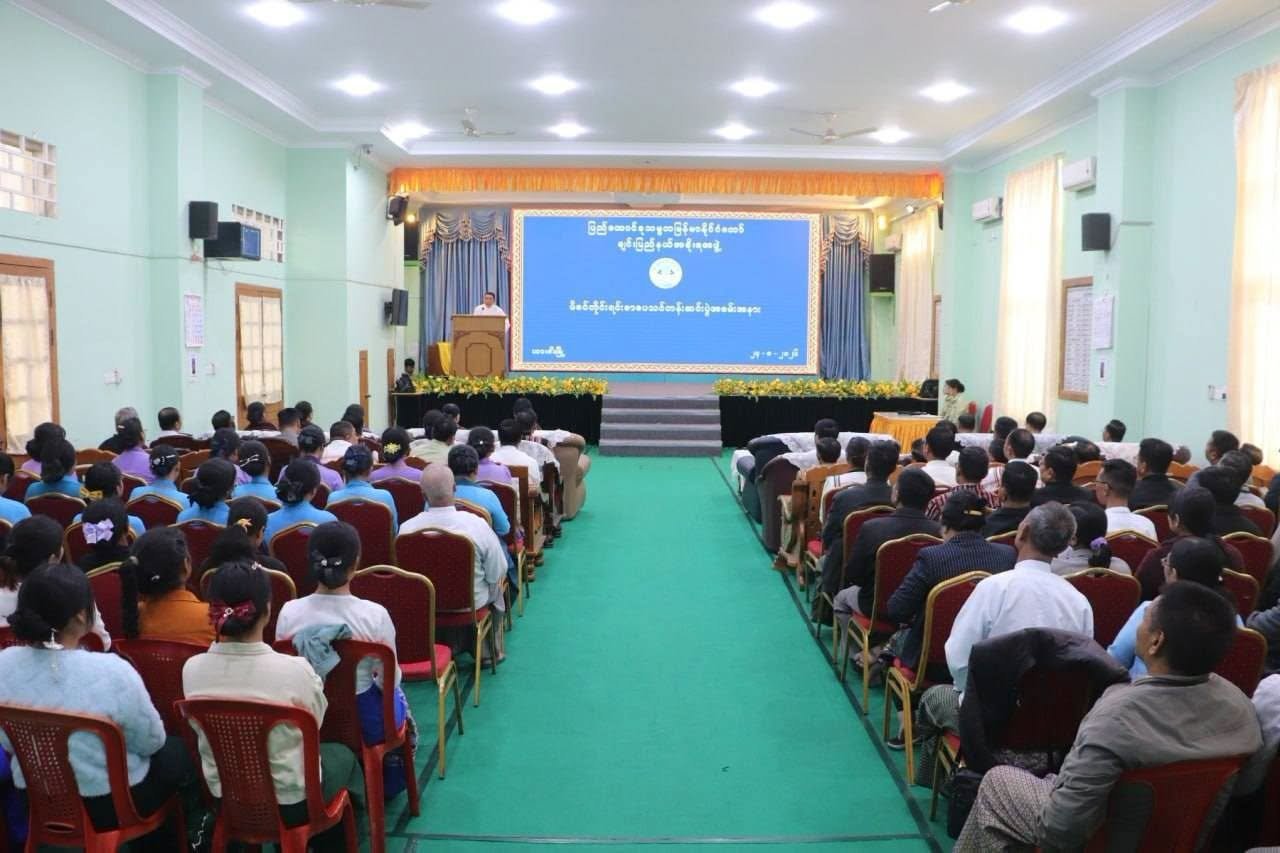
HAKHA, Chin State — September 25, 2026 — The revival of Zotuallai, the indigenous writing system associated with the Zo people, has gained renewed attention following the launch of traditional Zotuallai training classes in Hakha, the capital of Chin State, in August.
Dr. Vung Suan Thang, Chief Minister of Chin State, led an official ceremony marking the launch of the training programme. The initiative comes amid continuing armed conflict and shifting territorial control across Chin State, where the Myanmar military administration and ethnic resistance forces remain engaged in an ongoing struggle for control.
The Hakha programme represents one of the latest institutional efforts to promote a writing system that has experienced a significant decline in everyday use but has undergone renewed interest in recent years.
Zotuallai, also commonly referred to in scholarly and Unicode documentation as the Pau Cin Hau script, is an indigenous writing system associated with Pau Cin Hau, a Zomi religious leader. The script emerged in the early twentieth century and subsequently developed into both a complex logographic system and an alphabetic system.
According to research published by the Australia Myanmar Institute for Democracy, Human Rights and Peace (AMIDHRP), the logographic form contains approximately 1,050 characters, while the alphabetic form contains 57 characters, comprising consonants, vowels, final consonants and associated marks. The alphabetic form was incorporated into Unicode, providing the script with a foundation for use in modern digital technology.
The script was historically used for religious, literary and cultural purposes. Among the documented examples is a 1931 publication of the Sermon on the Mount in the Pau Cin Hau alphabet, demonstrating that the writing system was used for more than religious material associated exclusively with its original religious community.
Over time, however, the Roman alphabet became dominant following the expansion of missionary education and colonial administration. Zotuallai consequently became increasingly marginalised, although it continued to survive among sections of the community.
The renewed interest in Zotuallai has accelerated in the twenty-first century.
AMIDHRP's research describes the recent revival as being supported by digital communication, online educational resources, social media and renewed interest among members of the Zo diaspora. The research argues that modern revitalisation requires systematic documentation, standardisation, education and integration of the script into contemporary cultural and digital life.
The digital recognition of the alphabetic script has been particularly significant. Unicode encoding allows Zotuallai to be represented on computers and mobile devices, creating possibilities for digital publications, educational materials, websites and other contemporary applications.
Yet digital availability alone does not guarantee survival. The AMIDHRP study identifies continuing challenges including inconsistent information about the script, questions concerning standardisation and disagreements over its historical and cultural interpretation.
Alongside the renewed educational activity, Zomi leaders have proposed the enactment of a Zotuallai Act to establish a formal framework for protecting, preserving and promoting the writing system.
The proposed Act is intended to move Zotuallai revitalisation beyond individual and community initiatives by providing an institutional basis for areas such as education, documentation, research, standardisation, cultural preservation and digital development.
One of the proposals discussed in the revitalisation framework is formal recognition of Zotuallai as a national writing system of the Zo people. Under such a framework, the script could potentially receive greater support across educational and cultural institutions and become a common written heritage connecting Zo communities across geographical and political boundaries.
The proposal is significant because the Zo population is distributed across areas of Myanmar and neighbouring India, as well as a large international diaspora. Supporters of the initiative argue that a shared indigenous writing system could provide a cultural link between communities that have developed under different political, linguistic and national circumstances.
The Zotuallai Act remains a proposal and has not been enacted. Its eventual scope, legal status and implementation would depend on the relevant political and legislative processes.
“Not simply a relic of the past”
Zomi language and cultural advocate Go Suan Pau said the developments should be viewed as part of a broader effort to reconnect historical writing traditions with contemporary Zomi society.
“The launch of Zotuallai training in Hakha is an important reminder that our indigenous writing heritage is not simply a relic of the past. Zotuallai carries the history, identity and intellectual heritage of the Zomi people. Its revitalisation requires sustained community participation, quality education, scholarly research and digital development.”
Go said the proposed legislation could provide a longer-term institutional foundation for the revitalisation effort.
“The proposal for a Zotuallai Act reflects our aspiration to establish a lasting institutional framework so that future generations can learn, use and develop this writing system. We should preserve Zotuallai not only as an historical script, but as a living part of our cultural future.”
The launch in Hakha has taken place under extraordinary political and security circumstances.
Chin State remains one of Myanmar's principal conflict zones, with military forces and Chin resistance organisations contesting territory and political authority. Urban centres, including Hakha, have remained subject to heightened security measures as the conflict continues.
Against this background, the decision to conduct a formal programme devoted to an indigenous writing system carries cultural significance. It demonstrates that cultural and educational activities continue to take place in areas administered by the military-backed regional government despite the wider conflict.
At the same time, the involvement of the military-appointed state administration gives the initiative a political context that cannot be separated from the broader dispute over governance in Chin State.
The programme should therefore be understood on two levels: as a cultural and educational initiative concerning an indigenous writing system, and as an activity conducted within a highly contested political and security environment.
The Hakha classes are part of a much broader movement involving educators, researchers, community organisations and cultural advocates.
The current revitalisation agenda includes teaching the alphabet, recovering historical documents, improving documentation, developing digital resources and encouraging younger generations to learn the script.
AMIDHRP's May 2026 study argues that Zotuallai should not be treated simply as an historical artefact. Instead, it presents the script as part of the continuing cultural and linguistic heritage of the Zo people and calls for measures that would allow it to function in contemporary education, culture and technology.
The proposed Zotuallai Act represents another potential stage in that process: transforming cultural advocacy into a more formal policy framework.
For advocates, the objective is not necessarily to replace the Roman alphabet, which is now deeply established in Zomi education, literature and religious life, but to ensure that Zotuallai also has a sustainable place in the community's future.
The revival of Zotuallai illustrates a wider global challenge facing indigenous writing systems: whether historical scripts can move beyond preservation as museum objects and become usable components of modern cultural life.
For Zomi communities, the answer increasingly involves combining historical scholarship with education, community participation and digital technology.
The August ceremony in Hakha, the emergence of new training initiatives and the proposal for a Zotuallai Act all point toward a renewed effort to ensure that the script remains part of the cultural landscape.
Whether that effort develops into sustained institutional support will depend on education, community participation, scholarly research, standardisation and future policy decisions. For now, however, Zotuallai is experiencing a period of renewed visibility — connecting a writing tradition developed more than a century ago with a new generation growing up in an increasingly digital world.
Making a donation is the ultimate sign of solidarity. Actions speak louder than words.
© 2022 The Australia Myanmar Institute for Democracy, Human Rights and Peace Limited (AMIDHRP).
All rights reserved. Design by NWD.